
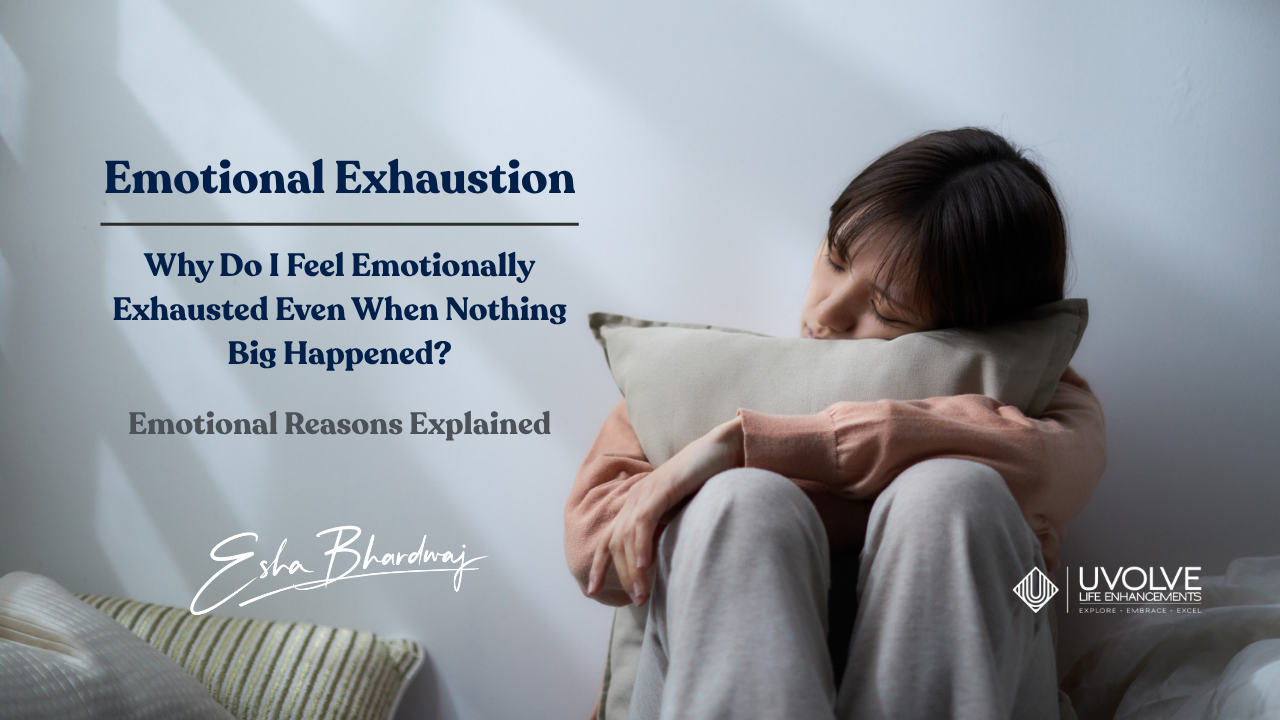
Why Do I Feel Emotionally Exhausted Even When Nothing Big Happened?
You may not have done anything unusually difficult, yet still feel deeply tired, irritable, mentally full or desperate for silence. Emotional exhaustion often comes not from one big event, but from everything you have been quietly carrying, processing and managing for too long. This article explores why that happens and what can actually help.
You wake up tired.
Not the kind of tired that disappears after coffee.
Not even the kind that makes sense after a terrible night of sleep.
It is a deeper tiredness.
You may have slept for eight hours and still feel like you need another eight.
You may look at your day and think, But I barely did anything. Why am I so exhausted?
Nothing terrible happened today.
You did not run a marathon.
You did not spend the entire day crying.
There may not even be one obvious problem you can point towards.
And yet replying to a message feels like work.
Making a small decision feels strangely difficult.
Someone asking you a simple question irritates you more than it normally would.
You want silence.
You want your phone away from you.
You want everyone to stop needing something for just a little while.
Sometimes you do not even want to talk.
And then comes the guilt.
Why am I this tired when other people are doing so much more?
Why can't I just get myself together?
Why do normal things feel so heavy?
Perhaps because your exhaustion is not coming only from what you have been doing.
It may also be coming from everything you have been carrying.
And some of the heaviest things we carry are completely invisible.
Emotional Exhaustion Does Not Always Come From a Big Crisis
We often imagine exhaustion as the result of something dramatic.
A breakup.
A death.
A major conflict.
A demanding job.
A health crisis.
A traumatic event.
And yes, experiences like these can leave us emotionally depleted.
But emotional exhaustion can also develop much more quietly.
It can happen when your mind has been managing a hundred tiny stresses for months.
When you have been worrying without calling it worrying.
Adjusting without noticing how often you adjust.
Holding back what you really feel.
Trying not to disappoint people.
Thinking through every possible outcome before making simple decisions.
Keeping yourself composed when you actually want to cry.
Trying to remain productive when something inside you desperately wants rest.
None of these moments may look significant individually.
But your nervous system does not experience your life as a list of dramatic events.
It experiences the accumulation.
A difficult conversation here.
An unresolved worry there.
A financial concern running quietly in the background.
Someone's mood you keep monitoring.
A relationship you are unsure about.
A decision you keep postponing.
Three nights of poor sleep.
Ten messages you do not have the energy to answer.
A responsibility you never truly get to put down.
Eventually, your system may simply begin saying:
I cannot keep processing this much without recovery.
You May Not Be Doing Too Much. You May Be Processing Too Much.
There is an important difference.
Two people can live through almost identical days and feel completely different by evening.
Because physical activity is only one thing that consumes energy.
Your brain also uses energy to monitor, anticipate, regulate, remember, suppress, decide and adapt.
Imagine spending an entire day quietly thinking:
Did I upset them?
Should I reply now?
What if this goes wrong?
I need to remember that.
I should have handled that better.
Why haven't they responded?
I really need to sort my life out.
I cannot deal with this right now.
I need to be more productive.
What if I disappoint everyone?
Your body may be sitting on a sofa.
But internally, you have been working all day.
That is why sometimes emotional exhaustion feels confusing.
From the outside, very little appears to have happened.
Inside you, almost nothing stopped happening.
1. You Are Constantly Thinking Ahead
Some people rarely experience the moment they are actually in.
While eating breakfast, they are already thinking about work.
While working, they are worrying about something happening later.
While talking to someone, part of their mind is analysing the conversation.
At bedtime, their brain begins reviewing everything that happened that day.
Your mind becomes a permanent planning department.
And because it feels normal to you, you may not recognise it as effort.
But constantly anticipating problems requires enormous mental energy.
You are not simply living your life.
You are repeatedly trying to protect yourself from what might happen next.
2. You Have Become the Person Who Holds Everything Together
Perhaps people describe you as strong.
Responsible.
Dependable.
Mature.
The one who manages things.
And perhaps you are.
But there is another side to being the person everyone depends upon.
You may rarely get to completely collapse.
Someone needs reassurance.
Someone needs a solution.
Something needs organising.
Someone needs you to remain calm.
You become so accustomed to being capable that even you stop noticing how much you are carrying.
Until one day you find yourself irritated by somebody asking you one harmless question.
Not because the question was unreasonable.
But because somewhere inside you, something whispers:
Can nobody handle anything without me for five minutes?
That irritation is sometimes exhaustion asking for space.
3. You Are Suppressing More Feelings Than You Realise
You do not necessarily have to cry to be struggling emotionally.
Sometimes emotional exhaustion comes from continually telling yourself that what you feel is not important enough to feel.
It wasn't a big deal.
There is no point getting upset.
Others have it worse.
I should just move on.
I don't want to create drama.
So disappointment gets swallowed.
Anger gets softened.
Sadness gets postponed.
Loneliness gets distracted away.
And hurt gets intellectually explained.
But emotions that are not expressed do not automatically disappear.
Sometimes they simply become internal work your system keeps carrying.
You may eventually stop feeling obviously emotional.
You simply feel tired.
4. You Are Constantly Reading Other People's Moods
Someone walks into the room and you immediately notice their tone.
Their face.
The way they closed the door.
Whether they sound irritated.
Whether their message seems shorter than usual.
Whether they are disappointed in you.
You may call this being observant.
Sometimes it is.
But if you feel responsible for detecting emotional danger before it reaches you, your attention may rarely switch off.
You are not only having conversations.
You are also monitoring them.
Are they angry?
Did I say something wrong?
Should I explain myself?
Are we okay?
That constant emotional scanning can become exhausting, particularly when it has been happening for years.
5. You Are Making Hundreds of Tiny Decisions
What should I eat?
Should I answer this?
Do I go?
Do I cancel?
Should I say something?
Should I ignore it?
Which task should I start?
What should I buy?
What should I wear?
Should I call them?
Should I wait?
Modern life contains an extraordinary amount of decision-making.
And when you are already emotionally overloaded, even small choices can begin feeling disproportionately difficult.
This is why you may stare at a food delivery app for twenty minutes and eventually close it without ordering anything.
It was never really about choosing dinner.
Your brain simply did not want one more decision.
6. You Have Not Had Real Rest in a Long Time
Rest and inactivity are not always the same thing.
Scrolling while worrying is not rest.
Watching television while answering messages is not rest.
Lying in bed while mentally planning tomorrow is not rest.
Taking a day off while feeling guilty for taking a day off is not rest.
Real rest includes moments where your system understands:
Nothing is required from me right now.
No performing.
No fixing.
No anticipating.
No responding.
No proving that the rest was deserved.
Many emotionally exhausted people are technically stopping.
They are simply never fully switching off.
7. You Are Carrying Unfinished Emotional Business
There may also be things in your life that technically ended but never truly settled inside you.
A conversation you never had.
A relationship whose ending still does not make sense.
An apology you never received.
A decision you know you need to make.
A version of your life you quietly mourn.
A family dynamic you keep trying to understand.
A future you expected that never happened.
These experiences can occupy emotional space even when you are not consciously thinking about them.
Sometimes we become tired because part of us is still trying to solve something that has no clean solution.
8. You Have Been Living in "Just Get Through Today" Mode
There is a particular kind of exhaustion that comes from functioning rather than living.
You wake up.
Complete what is urgent.
Handle people.
Manage responsibilities.
Get through the day.
Sleep.
Repeat.
Nothing is catastrophically wrong.
But nothing is truly replenishing you either.
There may be very little play.
Very little curiosity.
Very little excitement.
Very little time where you feel completely yourself.
Life gradually becomes an endless series of things to manage.
And eventually even an easy day feels exhausting because you have not recovered from the previous hundred.
Why Do I Sometimes Become Irritable When I Am Emotionally Exhausted?
Because exhaustion reduces your emotional bandwidth.
Imagine having twenty browser tabs open on your computer.
Everything technically still works.
But the system becomes slower.
One additional tab suddenly feels unbearable.
Emotionally, something similar can happen.
A small inconvenience that you would normally handle easily suddenly feels enormous.
Someone chewing loudly irritates you.
A phone call feels intrusive.
A simple request makes you angry.
You may want everyone to leave you alone.
It does not necessarily mean you have become rude, selfish or intolerant.
Sometimes your internal capacity is simply full.
Why Do I Want to Be Alone When I Am Emotionally Exhausted?
Because interaction itself requires energy.
Listening.
Responding.
Reading facial expressions.
Finding words.
Showing interest.
Making decisions.
Regulating how you sound.
Even loving people can feel tiring when you are depleted.
So your desire for solitude may not mean you dislike anyone.
Sometimes your system is simply trying to reduce incoming stimulation long enough to recover.
The important question is not:
Why am I withdrawing from everyone?
It may be:
What has been demanding so much from me that being alone finally feels like relief?
What Actually Helps Emotional Exhaustion?
The solution is rarely forcing yourself to become more productive.
If anything, continuously pushing an overloaded system can make the exhaustion worse.
Start by becoming curious about what is consuming your energy.
Not only physically.
Emotionally.
Ask yourself:
What am I constantly thinking about?
Who am I constantly worrying about?
What am I pretending does not bother me?
What decisions have been hanging over me?
Where am I giving more than I genuinely have available?
When was the last time I rested without feeling guilty?
You may discover that your exhaustion has been trying to communicate something for quite some time.
Reduce What Your Brain Has to Hold
Write things down instead of remembering everything.
Simplify unnecessary decisions.
Create routines for repetitive tasks.
Answer messages when you have capacity rather than remaining permanently available.
Finish small unresolved tasks that have been occupying mental space.
Decide what genuinely needs your attention and what can wait.
Your mind does not need to be the storage room for your entire life.
Give Yourself Small Pockets of No-Demand Time
Recovery does not always require disappearing for a week.
Sometimes it begins with twenty minutes where nobody needs anything from you.
No phone.
No conversation.
No productivity goal.
No self-improvement project.
Maybe you sit quietly.
Take a shower.
Walk.
Stretch.
Drink tea.
Listen to music.
Look outside.
The activity itself matters less than the message underneath it:
For these few minutes, I do not need to perform.
Stop Automatically Calling Every Feeling an Overreaction
You may be tired partly because you constantly negotiate against yourself.
Something hurts and you explain why it should not.
Something angers you and you immediately defend the other person.
Something overwhelms you and you tell yourself you are being dramatic.
Try replacing judgement with curiosity.
Instead of:
Why am I reacting like this?
Try:
What is this reaction trying to tell me?
Sometimes the answer is remarkably simple.
I need rest.
I need help.
I need clarity.
I need a boundary.
I need to cry.
I need to make a decision.
I need something to change.
Let People Carry Their Share
You do not have to anticipate everyone's needs.
You do not have to solve every uncomfortable emotion around you.
You do not have to respond immediately.
You do not have to prevent every misunderstanding.
You do not have to carry responsibilities simply because you are capable of carrying them.
Being able to hold something does not automatically mean it belongs in your hands.
Your Exhaustion May Be Information
Perhaps this is the most important thing to understand.
Your tiredness is not always evidence that you are lazy.
It may not mean you lack discipline.
It may not mean you are becoming weak.
Sometimes exhaustion is information.
It is your system showing you the difference between the life you are technically managing and the amount of energy that life is requiring from you.
And perhaps nothing "big" happened today.
But maybe you have spent months being strong.
Months adapting.
Months worrying quietly.
Months carrying conversations in your head.
Months being available.
Months pushing through.
Months telling yourself you were fine because nothing dramatic had happened.
Eventually the body stops asking whether your struggles qualify as big enough.
It simply asks for recovery.
So the next time you find yourself thinking,
Why am I so tired? I barely did anything.
Perhaps ask a different question.
What have I been carrying that nobody can see?
Because sometimes the exhaustion finally makes sense when you stop measuring your life only by what you did today and begin noticing everything you have been emotionally holding for much longer.
Continue reading
Why Do I Overthink Everything? The Emotional Reasons Your Mind Will Not Stop
Replaying conversations, doubting decisions or preparing for every possibility? Understand why you overthink and learn gentle ways to step out of the loop. I suggest you read this one with a cup of tea in your hand.
Read article Self-GrowthWhy Do I Feel Guilty When I Choose Myself?
Why does saying no, resting or setting a boundary make you feel selfish? Understand how people pleasing, family conditioning and self-abandonment create guilt and how to choose yourself without becoming uncaring or losing the relationships that matter to you.
Read article Emotional WellnessWhy Do I Keep Repeating the Same Patterns Even When I Know Better? Emotional Reasons Explained
Have you ever wondered why you keep repeating the same mistakes, choosing similar relationships, ignoring red flags, or ending up in situations that leave you emotionally exhausted, even when you know better? This article explores the hidden emotional reasons behind repeated patterns, how childhood experiences and your nervous system shape your choices, and how understanding yourself with compassion can help you finally choose differently.
Read article